(THIS IS PART 2 OF DUE DILIGENCE ON THE WSL)
Most folks in my home country Brazil won’t say it this way, but a sports league is both content and a production company by itself. Nothing more. This is why Hollywood business moguls like Ari Emanuel love them. Unfortunately, Ari does not seem very interested in the WSL (I have actually asked him). Why not? He never said, which is good. My best guess is because it’s an imperfect product lacking a proven business model (most importantly the latter), in both cases ultimately due to the unwillingness of our uneducated tribal community.
In that sense, the growth hacking orientation of the new WSL (Dirk Ziff’s) seems completely accurate. By this orientation I mean immediately shipping a product version consumable by all your friends, instead of just you, Mr. Surf Expert For Real dear reader. That means it doesn’t matter if some hard to fix code flaws persist (say the judgment system). Growth is the goal for a reason. On one side, the old size model accounted for a poor business (and a bad investment). How do I know? If you’re up for sale for decades and no one shows up, the market tells me. On the other hand, the more it grows, the more the innovation-avert dinosaurs get diluted.
Now, if you’re up to rebrand some old odd content into something new, viral, mainstream emergent, odds are that you might first succeed in emerging economies. In the old surfing universe, that meant Brazil, namely. Nonetheless, attacking young mainstream audiences in emerging countries with a product written in imperfect code, as small as a flaw may be, is somewhat similar to bringing a knife to a gunfight. If you have an Instagram account, you don’t even have to speak Portuguese to confirm that.
Because of that, empirical content analysis gets lost in everyone’s sight. I too happen to follow the WCT steadily since 1994. Honestly, I don’t think it ever was nearly as good to watch as it is today. Replays, 4k, angles, spinoffs. Sure, one may feel that somewhere between 2-20% of results may be ill, on average (or 20-60%, if you ask some lunatics). But again, it’s a flat out lie to say that anytime before (ASP) it was any better. It never was.
So, should the WSL’s growth model embrace haters? Doesn’t it already? If so, maybe their Brazilian experience lead up to follow on strategic meetings that look something like this:
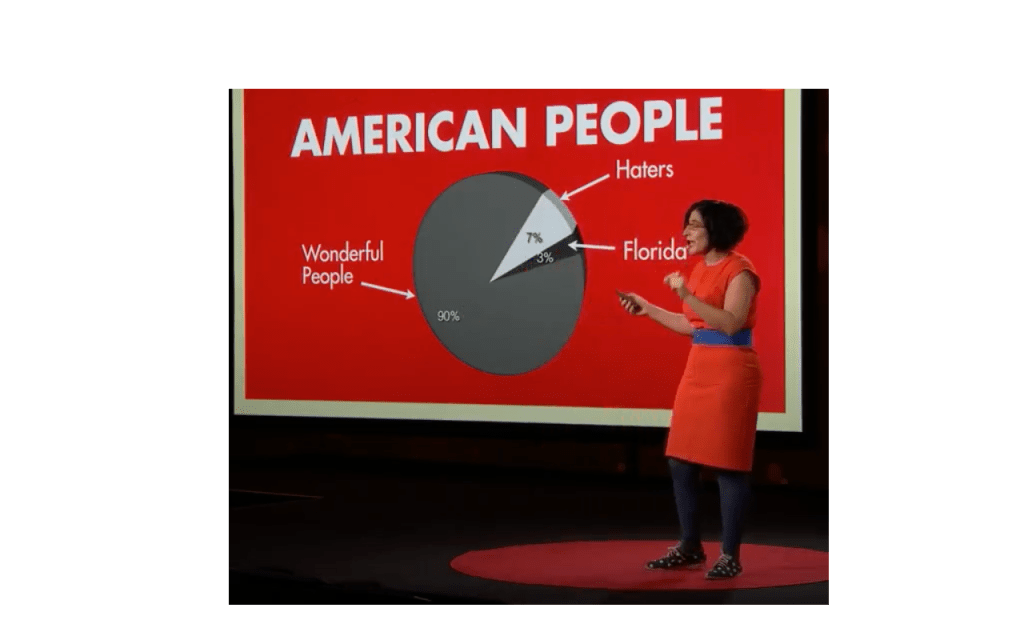
This joke paves way to my central claim: this is the perfect time to arm the rebels and start a new league. Firstly, because too many key athletes and fans are pissed. Secondly, because dealing with that means WSL is overloaded, paddling out through the white water under stormy conditions (which always looks bad).
What is the business model?
Honestly, I don’t know what the WSL business model is, and I don’t even know if they do have one. That is because for people from the audience who are actually clueless in running a business, this may sound like a simple question, but it is not. It’s more about a deep, existential and tricky answer. For example, you may be executing a vision under which you invest your limited resources (a certain human expertise, fixed assets, etc), while a simple breakdown of your real revenue sources says something else.
Moreover, WSL does not disclose its balance sheets and everything I do know comes from rumors, typically in forms that sound as fishy as the controversial results debates. The fact is that WSL has never shut down its operation, despite all rumors. So for the sake of the argument, it shouldn’t really matter, essentially, if they’re financing more runaways or making ends meet. Wherever they are, a new league can be. By hitting the market with a copycat product minus the minor code flaws (say a hedge judge), the new contender would be ok. Or would it?
Of course, to keep our guesses in those even terms, we have to assume zero capex, as if Dirk Ziff had come to us and said “Hey, I have a gift for you: sign this and WSL is all yours, everything within it, for zero dollars.” Not the case, so far. So, in order to take everything from him and end up exactly where he is (assuming that is a good spot if we actually know how to create value from there, but will get to that), the only math we should care is how much do we need for a hostile takeover of all their assets, and how the hell will we yield any return to that money provider (investor), whatever the amount is.
To me, this is where the fun starts.
“Surfing is the new golf.”
Do you guys play golf? While I can concede to Kelly Slater that golf may be a fascinating infinite other-game with oneself, I’ll stick with jiu jitsu as a second sport for that function (and lots more!).I sure don’t follow golf or know anything more than what reaches the headlines. Which is actually highly suggestive here.
Professional golf is an elitist competition sport, traditionally owned by fat cats called PGA. They make U$1.6 billion a year as a sports league. Therefore, unlike surfing, all their former elite players are typically millionaires. For decades, all that wonderland ran smoothly and boringly, until…
Well, here’s the plot: someone inside the monarchy of Saudi Arabia thought golf was a good idea. Not for hobby, but for another pet project in their country’s geopolitical agenda (and in their excess of liquidity diversification problem). Apparently, however, they looked at PGA and thought something like “Nah, that’s small shit”. I am assuming that because their next step was very public: “Let’s create our own world league!”. And off they went. Armed with U$2 billion in cash, they approached the best (PGA) players directly and offered them guarantees.
So Tiger Woods was offered (reportedly) U$800 million (that’s right!) in cash, which he turned down. Phil Mickelson was offered (reportedly) U$200 million, which he took. At that point, seven of the top 10 athletes in the business accepted the offer. Lo and behold, LIV Golf was born, effectively disrupting PGA’s monopoly.
Needless to say, the old elite did strike back. Careers were threatened. As fear scaled up, PGA’s CEO Jay Moynihan immediately reminded the players (and sponsors, fans, media, everyone) of 9/11, the Saudi’s resume and its reputational laundry agenda. Hypocrisy made the headlines for a while. Some players were bullied.
Interestingly enough, the former president of The United States joined the trash talks himself. But in a rare showcase of Economy Theory knowledge, Donald Trump was quite prophetic:
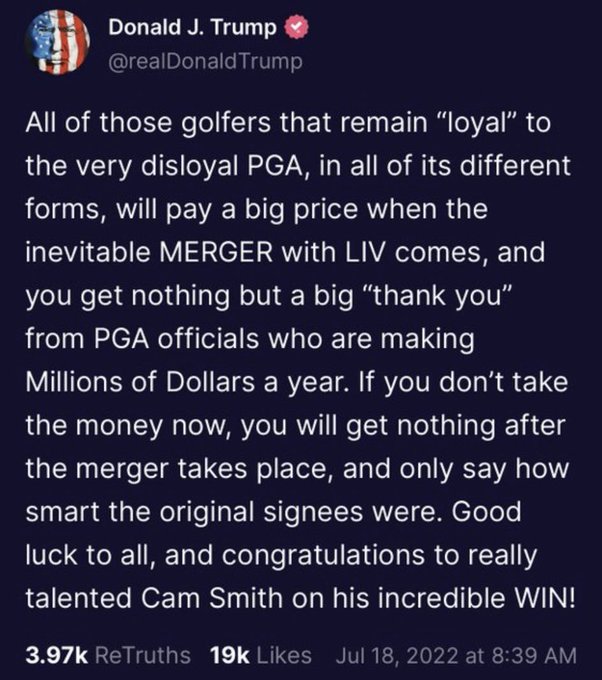
Now… Here we are, two years later. Trump was spot on. LIV Golf and PGA have just announced their merging.
Within just two years, minor updates were discussed and made all across the outdated golf business model. Mercenaries and loyals, or smart and idiots if you will, will all play under one single ranking, once again. Golf wins. The new league’s CEO name? Jay Moynihan, with a reportedly U$14 million basic salary. Money wins, too. Who knew…
“I’ve never ever got a phone call like that in my entire life“, might argue one of the current world stars like Medina, Florence, Ewing or Toledo. Well, maybe you will.
How much this should cost?
Remember, the Saudis offered the players (and executives, staff) a salty guarantee. “Even if sponsors don’t buy into it, licenses don’t get issued or distribution channels refuse to broadcast it, you still get paid.” But with every asset aboard, why would any of those market forces refuse to play ball? Fans would be more curious and eager to watch than ever, probably. Anyway, how much that ticket should cost for surfing?
My guess is that WSL’s annual revenues are more to U$ 50million than to U$1.6billion, and I wouldn’t be surprised if it is only a third of that (U$16 million, which is roughly 1% of PGA). WSL produces worldwide events that are actually owned (public license) by third parties (say Rip Curl in Bells), and while those events run under their brand and account for their core product, it’s not anywhere obvious how they are cast in the league’s balance sheets.
In other words, if the opex is low (think of Rip Curl as a landlord in Bells Beach and WSL as just the Airbnb platform) one can survive (or do well) with small or volatile variable income.
Just for comparison: if WSL’s net worth is 3% of PGA at least (lets just concede that since following suit of other sports they’re also doing revenue shares with streaming) and the saudis were up for it with the same multiple, all we need is a “modest” U$60 million seed investment (shit, we should have ICOed that before the meltdown of risky assets and crackdown of crypto, so we would be talking about a DAO).
Would Felipe Toledo take a U$6 million cash guarantee to part ways forever (reads: shortly) with WSL? Would Italo? Maybe collectively, they all would. They are tired, anyway. According to similarweb, Brazil alone is 32% of WSL’s online traffic, and unreasonably or not, that audience is eager for a change. Thats not to say the creation of a new league can rely more on certain nationalities than on others. No, every single worldwide fan must be represented, or it’s a nonstarter. All I am saying is that for some athletes, the pivot may be a no-brainer.
Formally sporty vs really entertaining
In the name of entertainment (aka commercial reasons), sport’s fairness structures should be pushed to a maximum point of stress where it still doesn’t break. Not a millimeter less (unless you are well funded), not a millimeter more. This is the book speaking, and I wholeheartedly disagree with critics of Sophie Goldsmith and Erik Logan in that sense, as they did exactly that: there’s only one way to find that sweet spot, which is by experimentation. By design, most experiments fail. Specially in their early days.
For decades, there was no such thing in the surfing world as speculating “how much ASP worth?” They were just an association running under former pro surfers with a talent for politics, presumably worthing not that much by itself. A lot has been improved since Ziff came in, and its amazing how we forget it. But a lot more remains same, too, or would have evolved with technology anyway.
I have been interested in helping the creation of a rebel league. Nokandui alone, though. Anywhere to apply?
 P-Pass